Warning: Some hyperlinks in this article may lead to pornographic or otherwise inappropriate content. They are included solely for documentation purposes and to allow readers to verify the findings of this investigation.
Over the past few months, advertisements for artificial intelligence applications have begun appearing systematically on Facebook, promising to turn a simple photograph into an image or video. At first glance, most of them looked like the hundreds of advertisements for AI tools currently circulating online. However, several used images and videos featuring visible nudity or even pornographic content, claiming that artificial intelligence could generate sexual content from a single photograph of a real person. In most cases, the advertisements promise that users can use artificial intelligence to create fake videos in which they appear to be having sex with any woman they choose, whether they know her or not.
These applications belong to the category commonly known as nudify or nudification apps. They are artificial intelligence applications capable of generating fake nude or pornographic images and videos of real people from one or more photographs, usually without their consent. In recent years, they have caused growing concern internationally, as they are used to create non-consensual sexual deepfakes targeting ordinary people, celebrities and even minors.
To date, public discussion has focused mainly on the technological capabilities of these applications and their impact on victims. Far less attention has been paid to how they are promoted and how they reach users. Our investigation began precisely from this point. Not with the applications themselves, but with the advertisements appearing on Facebook and the path users follow before installing them.
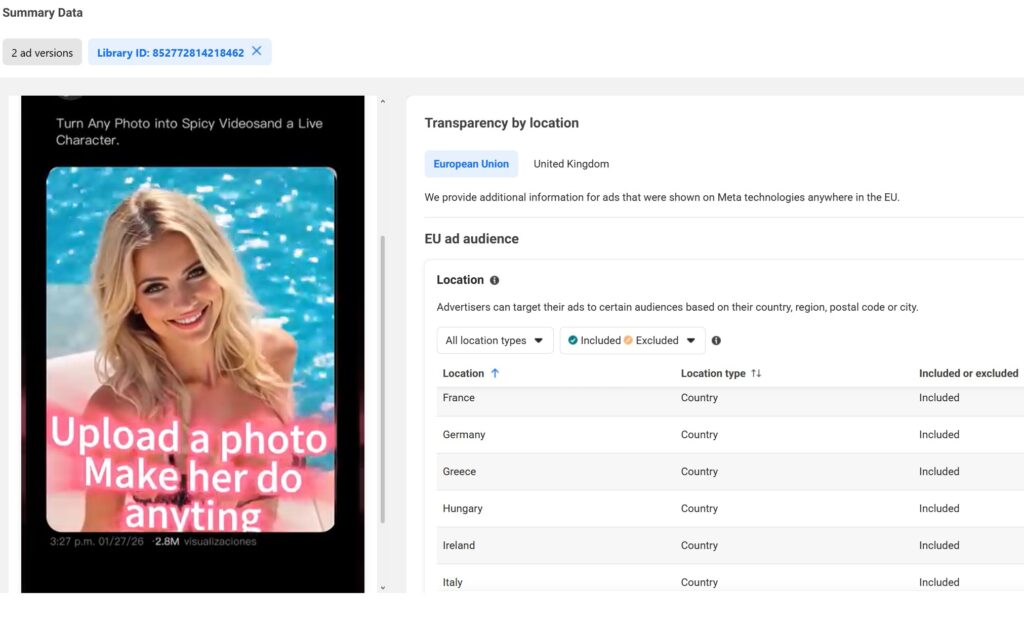
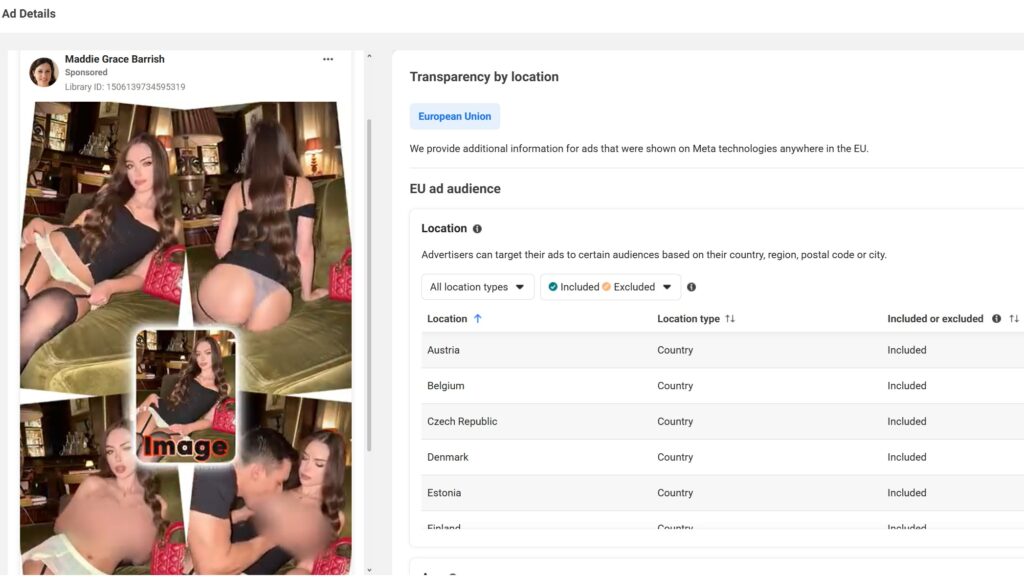
The pornographic content below was displayed as an advertisement through Facebook and targeted users in every country of the European Union. The screenshots have been edited to conceal the pornographic material.
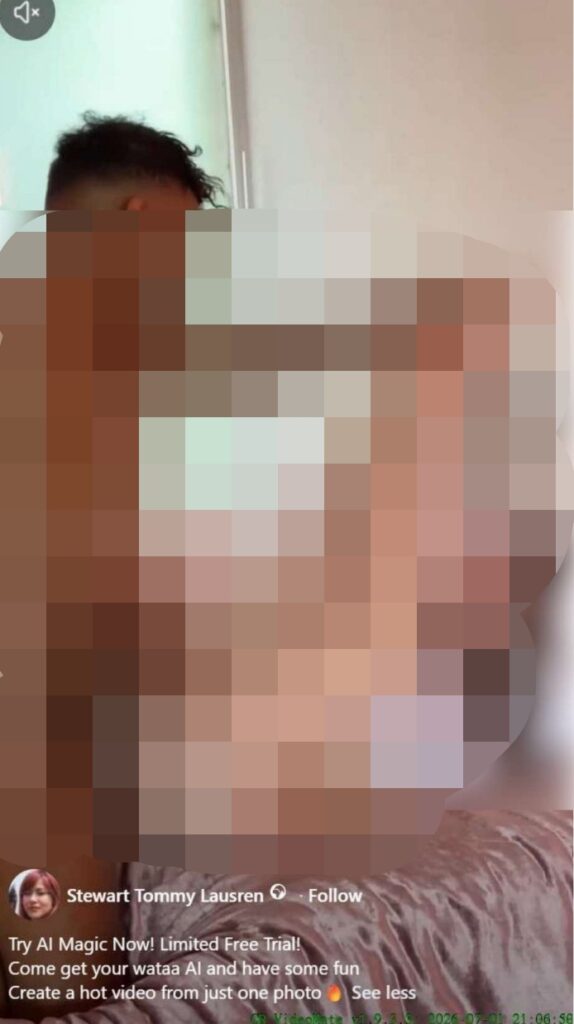
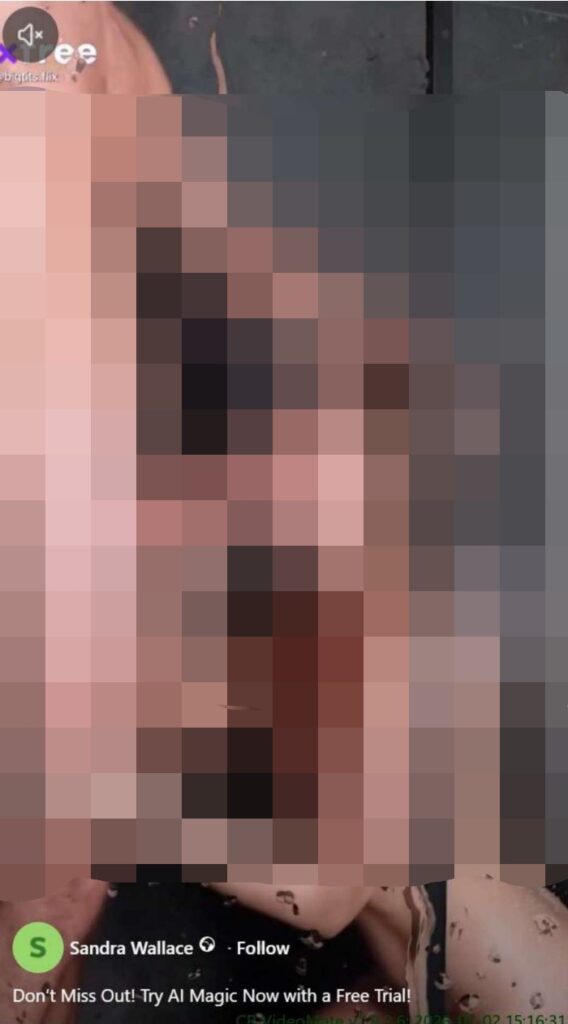
As part of the investigation, we documented 33 advertisements shown through Facebook that contained nude or pornographic content. Several of them led to the same application, resulting in the identification of 20 different applications in total. This number does not represent all related advertisements or applications currently in circulation, but rather a representative sample. New applications and new advertisements appear constantly, making a complete mapping of the phenomenon practically impossible.
Another noteworthy finding was that these advertisements were not aimed exclusively at the Greek market. According to data from the Meta Ad Library, all of them were shown in European Union countries, including Greece and Cyprus. This is therefore a practice targeting a broad European audience, rather than isolated cases confined to a single country.
Our investigation found that almost all the advertisements led to Google Play, in 16 cases. Of all the applications we documented, only four were not available through Google’s official app store. More specifically, three led to websites offering AI-generated pornographic content (Fluxeo, NSFW AI Studio and OKBOX AI) while one led to the Apple App Store (SciVisionAI – AI Lens Maker). All the remaining applications could be installed directly by any Android user.
Although the applications had different names, their advertisements showed striking similarities. They used almost identical graphics, similar promotional messages and a common visual style, creating the impression that they came from the same advertising template, even when they had been developed by different companies.






On Google Play, we identified applications with different names, including Moviddy, Vidsora AI Motion Studio, Snapvai AI, Reelix, FacDreamer, Kinpics, HeloSwap, HaMirror, Omnipx, CreatNow: AI Video & Photo, Sintry: Swap & Roleplay, AgainAI, FastVid AI: Photo to Video, Fantasia AI: Video Maker and Zynthera, among others. These applications had download numbers ranging from 1,000 to more than 100,000. Although they came from different developers, many displayed notable similarities. Their descriptions referred to AI video creation, photo editing, portrait generation, animation or face swapping.
The business model was also almost identical in every case. The applications were free to install, but most functions required a paid subscription. Users could try the application on a limited basis, but had to pay to gain full access to its features.
What stood out most, however, was not the applications themselves, but the difference between the way they were promoted on Facebook and the way they were presented in the official app stores.
In almost every case, the Facebook advertisements used nudity, or even pornographic content, as their primary means of attracting users. The images and videos did not simply promote an AI-powered image or video generation tool; they clearly suggested that the application could generate sexually explicit content from a single photograph of a real person.
That picture changed dramatically the moment users followed the advertisement’s link. On Google Play and the Apple App Store, the very same applications were presented as general-purpose AI tools for creating and editing images and videos. Their descriptions referred to features such as video creation, photo editing, portrait generation, animation or face swapping, without using the same visual material or language found in the Facebook advertisements. The three websites, by contrast, linked directly to pornographic content.
What becomes evident is that users receive two entirely different messages. The first comes from the advertisement they see on Facebook, which uses nudity or pornographic content to capture their attention. The second comes from the application’s official listing on Google Play or the Apple App Store, where the very same application is presented as a general AI image-editing tool.
This difference does not appear to be accidental. The policies of both Google Play and the Apple App Store prohibit applications that contain or promote pornographic content. More generally, AI image and video generation applications are permitted provided they comply with the platforms’ policies. Developers of these applications therefore cannot use pornographic, or even nude, content in their official app store listings. Our investigation shows that this content is instead shifted to advertisements displayed through Meta’s platforms, which serve as the primary means of attracting users. This practice is linked to the fact that advertisements are subject to different content moderation mechanisms from those applied to official app stores.
Who pays for advertisements on Meta?
The Meta Ad Library displays both the advertiser, namely the account running the advertisement, and the payer, namely the company that finances the advertising campaign. Our investigation found that the payers were not always the companies that developed the applications themselves. In several cases, they were third-party companies that appear to be responsible for promoting these applications through Meta’s platforms.
Among the companies we identified were HONGKONG GATHER WISDOM NETWORK TECHNOLOGY CO., LIMITED, 飞书深诺数字科技(上海)股份有限公司 (MeetSocial) and Datong Jiayuechen E-commerce Co., Ltd.. At the same time, in many cases the information displayed in the Ad Library does not allow the real advertiser or payer to be easily identified, as commercial names or pseudonyms are used instead of the details of the legal entity, that is, the application, that ultimately benefits from the advertising campaign.
The findings of our investigation become even more significant considering that Meta itself has publicly acknowledged the problem posed by “nudify” applications. In June 2025, the company announced that these applications are being used to create fake nude or pornographic images and videos of real people without their consent and that they represent one of the most significant challenges currently facing its platforms.
According to the company, Meta has strengthened its automated systems for detecting such advertisements, removed accounts promoting them, developed new techniques to identify advertisements even when they do not use obvious keywords, and has even taken legal action against companies that, according to Meta, attempted to circumvent its enforcement systems.
Although many such advertisements appear to be rejected by Meta’s moderation systems, our investigation shows that many continue to be approved and displayed across its platforms.
The findings of our investigation are not an isolated case. In January 2026, the Tech Transparency Project (TTP) published an investigation showing that dozens of “nudify” or “undress” applications remained available on both Google Play and the Apple App Store, despite the policies of both companies. The researchers identified 55 such applications on Google Play and 47 on Apple’s App Store, 38 of which were available on both platforms.
According to the same investigation, these applications had accumulated more than 705 million downloads worldwide and had generated approximately $117 million in revenue through subscriptions and in-app purchases. During TTP’s testing, several of the applications successfully generated fake nude or pornographic images and videos using photographs of clothed women. The investigation also points out that part of this revenue ultimately goes to Apple and Google through the commissions they collect from in-app purchases.
A few months earlier, in June 2025, CBS News had published an investigation reaching similar conclusions. It uncovered hundreds of advertisements across Meta’s platforms, primarily Facebook, Instagram, Messenger and Threads, promoting applications for creating non-consensual sexual deepfakes. The advertisements promised that users could upload a photograph and see anyone naked or generate sexually explicit content, even using photographs of celebrities.
According to Indicator.media (January 2026), Meta continues to display thousands of advertisements for AI tools that transform photographs into nude or pornographic material. Although Meta announced in June 2025 that it would drastically reduce such advertisements, the investigation identified at least 4,431 related advertisements published on or after 4 December 2025, directing users to 13 different websites and 6 applications.
Some of these advertisements also appear to promote scams, as they charge users without producing the promised results. One of the advertised applications had accumulated more than 100,000 downloads on Google Play and used deepfakes featuring well-known celebrities. The article highlights Meta’s inability to effectively control this type of harmful content despite its public commitments.
Meta notes that the developers of these applications constantly change their names, logos, websites and advertising material in order to avoid detection. For this reason, the company argues that tackling the problem requires continuous adaptation of its detection systems and cooperation with other companies in the sector.
However, the findings of the present investigation show that, despite the measures Meta has announced, such advertisements continue to appear to Facebook users in Greece and across the European Union. The advertisements we documented repeatedly used nudity, or even pornographic content, to attract users and direct them to artificial intelligence applications.
This finding does not mean that Meta is taking no action, nor does it mean that all such advertisements remain active for long periods of time. It does, however, show that the problem persists and that the company’s detection mechanisms do not prevent every relevant advertisement from reaching users before it is displayed.
Our investigation did not examine the technical capabilities of each application, nor did it seek to assess whether all of them can actually generate the content claimed in their advertisements. Instead, it focused on the way these applications are promoted to the public. The findings reveal a consistent pattern. The applications are presented in the official app stores as general AI tools for creating images and videos. The attraction of users, however, is often based on advertisements that use nudity or pornographic content and imply, or explicitly claim, that the applications can generate non-consensual sexual content from a single photograph.
As artificial intelligence tools become increasingly powerful and widely available, the issue no longer concerns only the applications themselves. It also concerns the way they are promoted, the responsibilities of the major digital platforms that host their advertisements, and the effectiveness of the mechanisms that are supposed to protect users from content capable of facilitating the creation of non-consensual sexual deepfakes.
The use of photographs of real people to generate fake nude or pornographic images and videos without their consent is expressly prohibited under both Greek and European law. Such material also constitutes “illegal content” under the Digital Services Act (DSA), triggering the obligations imposed on digital platforms to address it.
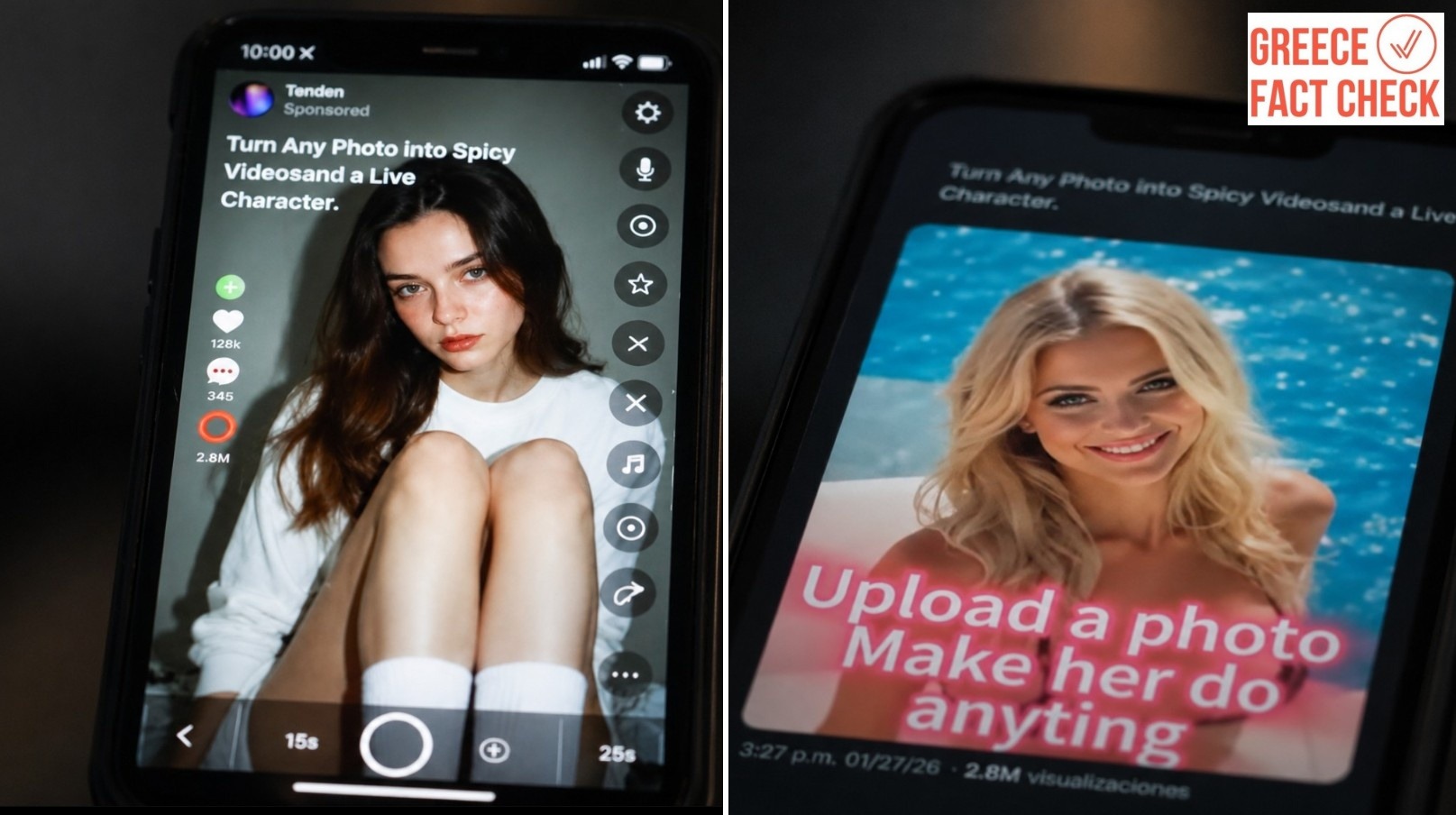
The cover image accompanying this article was created using artificial intelligence. The individuals depicted are not real, and any resemblance to actual persons is purely coincidental.