
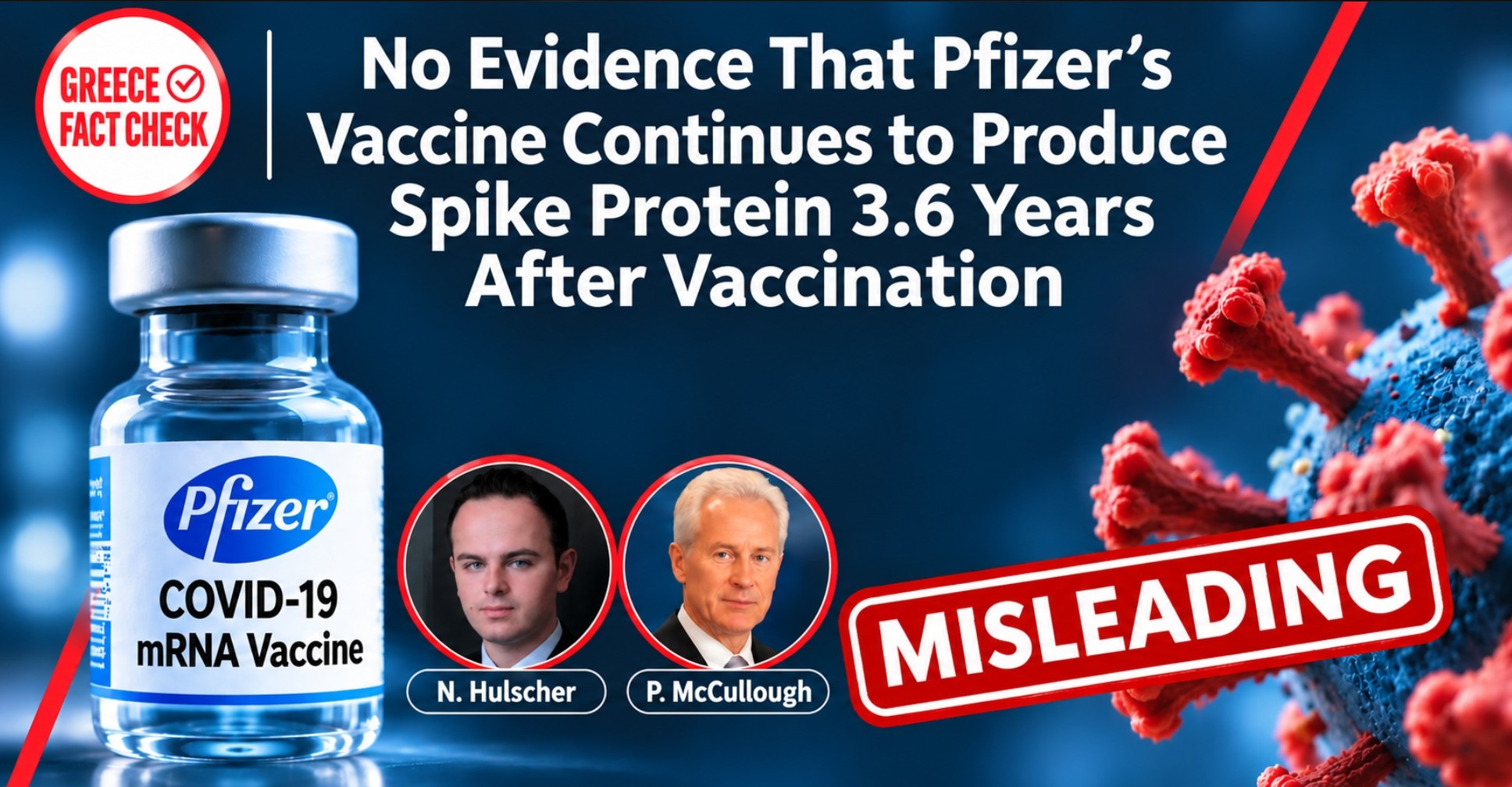
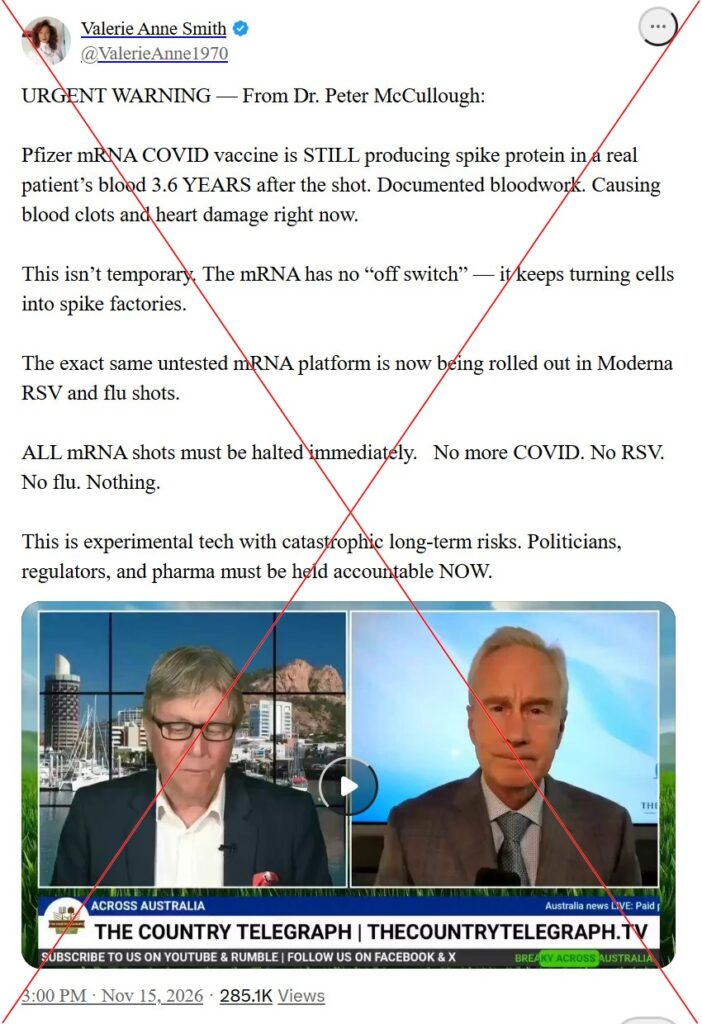
CLAIM: URGENT WARNING — From Dr. Peter McCullough: Pfizer mRNA COVID vaccine is STILL producing spike protein in a real patient’s blood 3.6 YEARS after the shot.
VERDICT: The study concerns a single patient and does not demonstrate that the Pfizer vaccine continued to produce spike protein for 3.6 years or that it caused the patient’s health problems. Furthermore, it was published in a scientific journal with a documented history of misleading publishing practices. Concerns about a conflict of interest also arise because co-author Peter McCullough has financial ties to a company that sells supplements marketed as products for supposedly removing spike protein from the body.
The claim circulated widely on social media. One notable example is a post by Valerie Anne Smith on X, published on November 15, 2026, which had garnered 285,100 views at the time of the screenshot.
The main authors of the study, a case report involving a single patient, Nicolas Hulscher and Peter McCullough, have a long history of spreading misleading and scientifically unsupported claims about COVID-19 vaccines. Hulscher is an epidemiologist and administrator of the McCullough Foundation, while McCullough is a cardiologist and the organization’s founder. Their claims have repeatedly been debunked by fact-checking organizations, including FactCheck.org and Science Feedback. Greece Fact Check has also examined their misleading claims concerning sudden deaths following vaccination and the alleged increase in seven types of cancer. In addition, there are serious concerns about a conflict of interest.
McCullough has served as Chief Scientific Officer of The Wellness Company, which sells supplements marketed for the supposed “detoxification” of spike protein. As FactCheck.org has documented, McCullough has stated that he receives part of his compensation from the company and holds an equity stake in it. He therefore has a financial interest connected to promoting a purported health problem for which the company offers products with no proven effectiveness. The new study reportedly involves a patient who followed his own protocol for detoxifying the body of vaccine-derived spike protein (Ultimate Spike Detox), which, however, lacks scientific evidence supporting its effectiveness.
The study, published in June 2026, concerns a single 55-year-old man in whom researchers report detecting spike protein more than three years after his COVID-19 vaccination. However, this does not demonstrate that the vaccine was still producing the protein or that the protein caused his health problems. A subsequent blood test did not detect the protein, although the researchers reported finding it in skin samples. Furthermore, the patient had experienced thrombosis and pulmonary embolism following surgery several years before receiving the vaccine. The authors did not conclusively rule out a previous coronavirus infection, and the study included no other patients for comparison. Consequently, the study does not demonstrate that the vaccine continued producing spike protein for nearly four years or that it caused the reported health problems.
The study by Hulscher and McCullough was published in Medical Research Archives, a journal of the European Society of Medicine, which states that it uses a peer-review process. However, the journal has drawn scrutiny within the scientific community over controversial publishing practices. In June 2021, a post on the University of Groningen Library’s website in the Netherlands described an incident involving misleading publishing practices associated with Medical Research Archives. Researchers were misled by an invitation to publish and believed they were submitting a paper to the established journal Trends in Immunology, when the invitation actually concerned Medical Research Archives. When they complained about the high publication fees, they were offered a discount of approximately 90%. The university presented the incident as an example of misleading and potentially exploitative publishing practices.
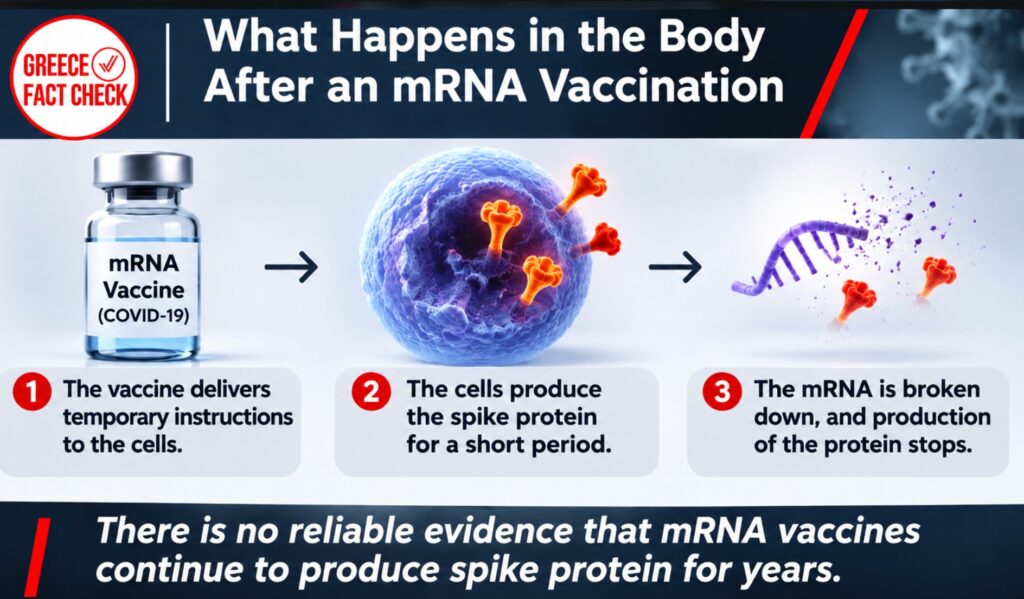
COVID-19 mRNA vaccines temporarily instruct the body’s cells to produce the coronavirus spike protein. This allows the immune system to learn to recognize the virus and protect against it. The mRNA is gradually broken down by the body, and production of the protein stops. The spike protein is also cleared from the body within a few weeks. There is no reliable scientific evidence that the vaccines continue producing spike protein for years after vaccination.
Conclusion
The study concerns a single patient and does not demonstrate that the Pfizer vaccine continued to produce spike protein for 3.6 years or that it caused the patient’s health problems. Furthermore, it was published in a scientific journal with a documented history of misleading publishing practices. Concerns about a conflict of interest also arise because co-author Peter McCullough has financial ties to a company that sells supplements marketed as products for supposedly removing spike protein from the body.