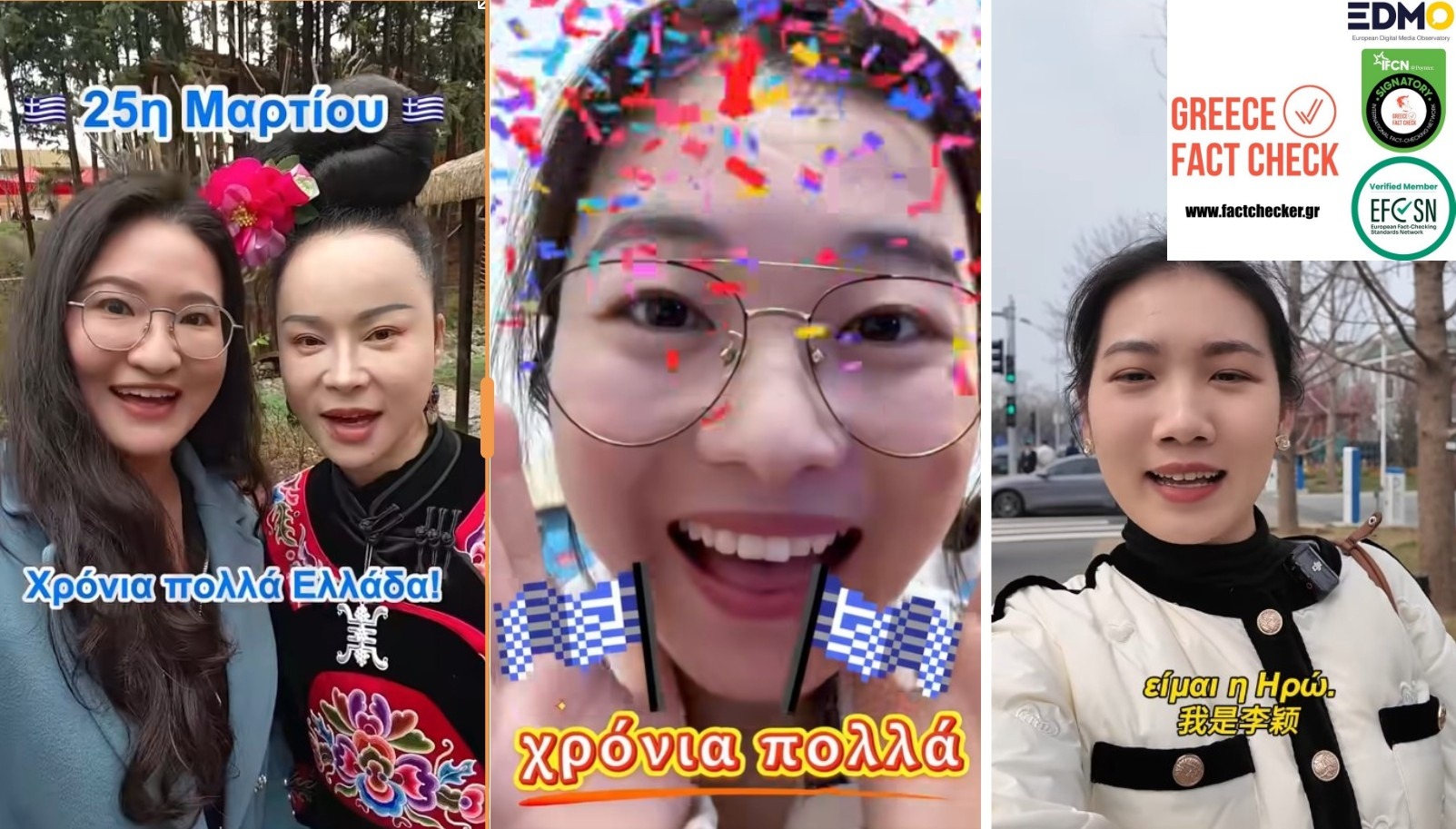
In the case of China, propaganda on social media, such as Facebook, often does not appear as political or state-driven communication. Instead, it is conveyed through female influencers who present entirely everyday and seemingly authentic moments.
A key element is what can be described as “role masking.” Many of these content creators present themselves as travel vloggers, food bloggers, or individuals showcasing their lives in China. However, in several cases it has been revealed that they are connected to or collaborate with state media. Their content is primarily lifestyle-oriented, but with a consistent direction: portraying China in a positive light while avoiding or countering criticism on issues such as human rights.
At the same time, there is a strong element of coordination. These are not simply isolated accounts, but networks that reproduce similar messages across multiple languages and platforms. This creates the impression of “spontaneous” opinions from many different individuals, while in reality specific narratives are being amplified. The fact that these are often female influencers is not accidental. This style of communication is softer, more personal, and more effective at building trust. Through everyday moments, emotional tone, and direct engagement with audiences, a sense of familiarity is created. Within this context, even political messages can be conveyed more easily and with less resistance.
Another important aspect is aesthetics and professionalism. The content is often visually polished and presents an image of China as modern, safe, and culturally rich. Instead of directly confronting criticism, it projects an alternative image of reality that persuades through visuals rather than argumentation.
This represents a more modern form of propaganda, where state narratives are not transmitted directly by official media, but are “packaged” as personal stories and experiences by individuals who appear independent and authentic. In reality, they are often employees of state media (such as CGTN, Xinhua, China Radio International).
Accounts targeting Greek-speaking audiences
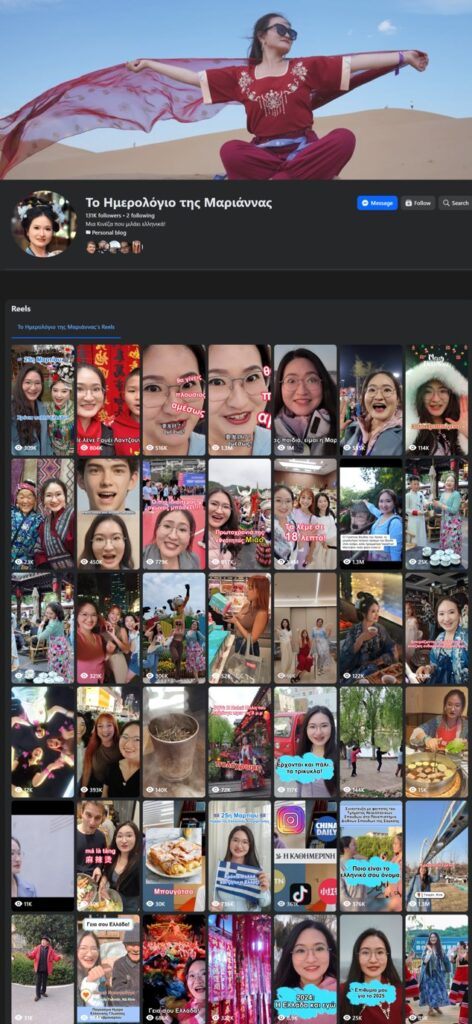
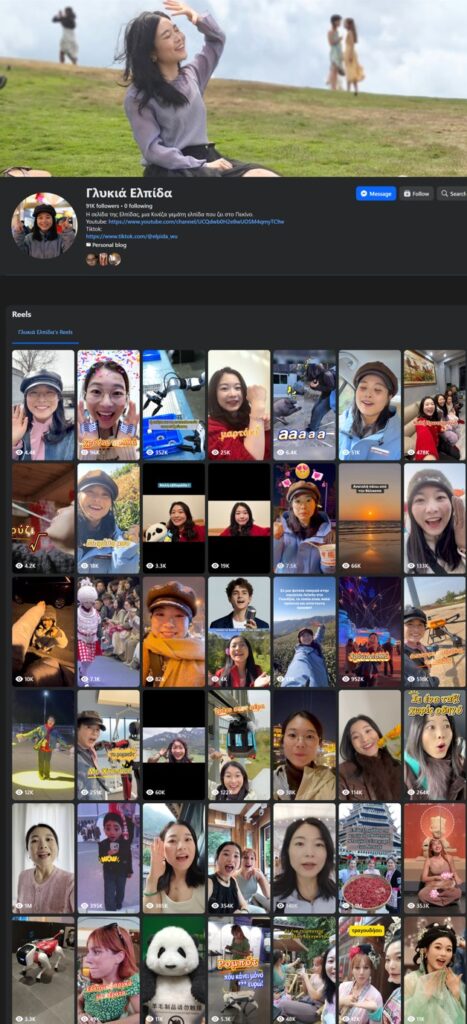
Two (out of 3 in total) Facebook pages targeting Greek-speaking audiences carry Meta’s official label of “China state-controlled media,” meaning Chinese state-controlled outlets. This means that:
“Meta has classified this publisher as state-controlled media because it believes it may be partially or wholly under the editorial control of a government. This assessment is based on various factors, such as funding, organizational structure, and journalistic standards.”
The Greek-language Chinese accounts on Facebook are as follows:
Το Ημερολόγιο της Μαριάννας (Mariana’s Diary)
Link: facebook.com/profile.php?id=100064961195623
Page name: Mariana’s Diary
Description: “A Chinese woman who speaks Greek!”
Followers: Approximately 131,000
Includes links to Instagram (1,061 followers) and YouTube (not available)
The Instagram account links to TikTok with 81,000 followers
(Category: Personal blog)
Meta label: China state-controlled media (displayed in the page intro)
Content style: Friendly, personal reels and posts in Greek, presented as a personal diary
Examples: Messages to Greece such as “Happy anniversary Greece! Greetings from friends of different ethnic groups in China!!!”, everyday life in China, cultural topics, crafts, nature, and positive messaging about China
Her exact identity is unknown, however, she works for state-controlled China Media Group.
Content often reaches hundreds of thousands or even over one million views
Γλυκιά Ελπίδα (Sweet Hope)
Link: facebook.com/profile.php?id=100064220677213
Page name: Sweet Hope | Beijing
Description: “Hope’s page, a Chinese woman full of hope living in Beijing.”
Followers: Approximately 91,000
Includes links to YouTube (107,000 subscribers) and TikTok (1,505 followers)
(Category: Personal blog – Beijing, China)
Meta label: China state-controlled media (visible in page transparency and posts)
Content style: Friendly, influencer-style content in Greek with a positive tone
Examples: Posts about spring in Beijing (“Happy celebrations everyone!! Long live Greece!! Where will you celebrate today?” “Spring in Beijing does not speak, it quietly awakens the beautiful flowers. I wish this wonderful season brings joy and happiness to all of you!!”), everyday life, seasons, flowers, and occasional themes of cultural friendship with Greece
Her real name is Yawen Wu (or Elpida Wu) and she works as a journalist at China Media Group, something not mentioned on her profile. Greek media have featured her for speaking fluent Greek
Content often reaches hundreds of thousands or even over one million views
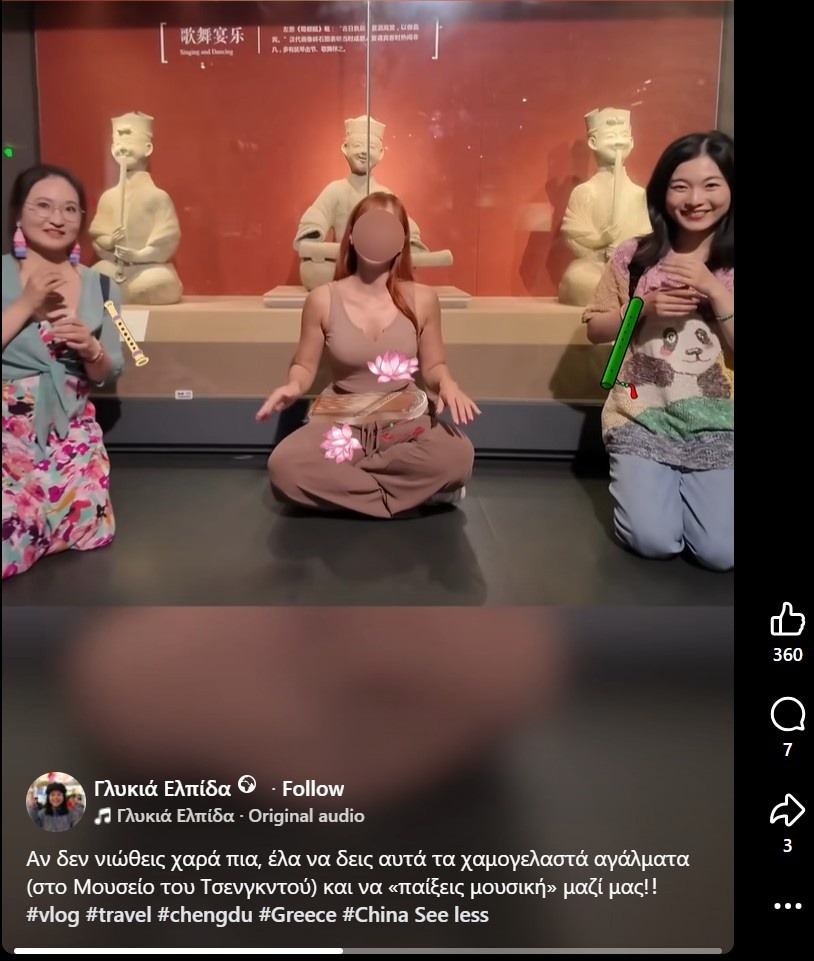
The above two women know each other and collaborate, although they do not openly promote this. In one photo, they appear together alongside a woman from Greece.
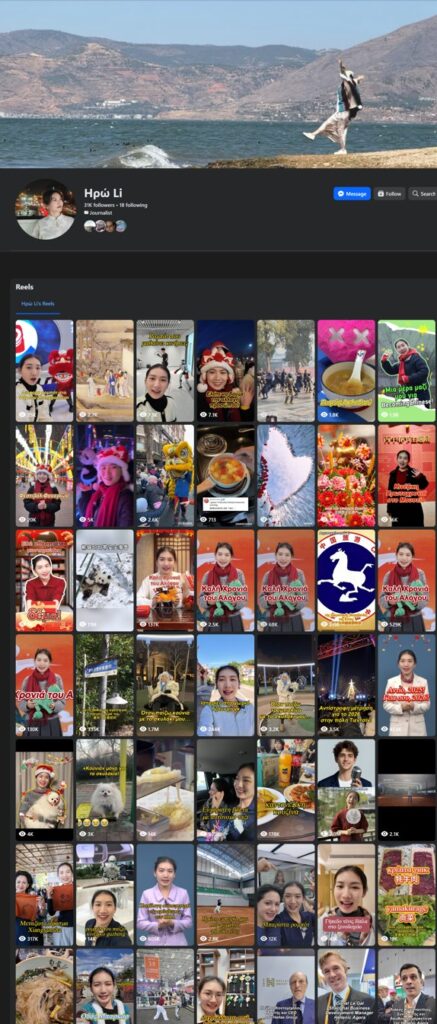
Another Facebook page, which does not carry Meta’s label, is the following:
Ηρώ Li (Iro Li)
Link: https://www.facebook.com/profile.php?id=100090452107575
Description: Presented as a young Chinese woman who speaks Greek (similar style to the other two)
Followers: Approximately 31,000
Includes links to Instagram (1,468 followers), TikTok (10,500 followers), and YouTube (123 subscribers)
Content style: Very friendly and positive
Posts in Greek
Topics: Everyday life in China, seasonal and cultural themes, Chinese holidays (e.g. Chinese New Year), snowy landscapes, panda videos, etc.
She is a journalist and in September 2024 interviewed the Regional Governor of Western Greece, Nektarios Farmakis, on behalf of the state-controlled China Radio International (CRI)
These three accounts together have over 455,000 followers and subscribers across Facebook, Instagram, TikTok, and YouTube. Combined with content that receives hundreds of thousands to millions of views, this indicates a strong footprint and reach among Greek-speaking audiences in Greece and Cyprus.
Regarding transparency, beyond Meta’s labeling of two of the pages as state-controlled, we see that they were created between 2021 and 2023, have 19, 18, and 10 administrators respectively, run advertisements, and two of them have run ads related to social issues, elections, or politics (according to Meta). These ads, although in Greek, target multiple countries, with particular emphasis on Greece and Cyprus. The first page has run 71 ads, the second 76, and the third 84.
The “intermediary”
The first two pages (Mariana’s Diary and Sweet Hope) use an intermediary for ad payments. In Meta’s ad library, the advertiser and payer is listed as a private company.
HONGKONG GATHER WISDOM NETWORK TECHNOLOGY CO., LIMITED is an online marketing company based in Hong Kong, founded in 2016. It specializes in performance marketing, Meta (Facebook/Instagram) advertising, influencer promotion, and international content distribution. This does not mean the company owns or creates the content. It means it manages or pays for the promotion of posts so they reach more Greek users. This is common among Chinese clients, as Hong Kong provides easier access to international platforms. It is a standard advertising/promotional company used, among other things, to boost the visibility of positive content about China.
In the case of the third page (Iro Li), however, funding is directly state-linked. In the ad library, the advertiser is listed as “中视前卫影视传媒有限公司”. This is a 100% state-owned company fully belonging to China’s Central Radio and Television (CMG/CCTV), and a subsidiary of China Global Television Corporation.
The payer is YinoLink (易诺), a professional advertising company based in Hangzhou, China. It operates as a service that opens and manages advertising accounts for Chinese clients on social media platforms, including state or state-linked entities.
A global phenomenon
According to an Associated Press report, China has developed an extensive network of social media “influencers” (TikTok, Facebook, Instagram, YouTube), where journalists and state media employees (such as CGTN, Xinhua, China Radio International) present themselves as independent travel bloggers, lifestyle vloggers, and “life bloggers.” In 2022, AP identified dozens of such accounts operating in 38 languages, with more than 10 million followers in total.
These accounts mainly publish positive, “light” content (daily life in China, food, travel, culture) to attract audiences, while ignoring issues such as human rights violations and promoting a positive image of the Chinese Communist Party and China’s positions on international issues (e.g. the war in Ukraine). The AP report describes exactly the practises that we’ve seen in the three Greek pages (Mariana’s Diary, Iro Li and Sweet Hope): young Chinese women presenting content as personal diaries, speaking Greek, using a friendly tone, and labeled by Meta as China state-controlled media.
According to Microsoft Threat Analysis Center (formerly Miburo), which specializes in foreign influence operations, more than 200 influencers aligned with the Chinese government and state media have been identified. They operate in around 40 languages and use platforms such as Facebook, Instagram, YouTube, and TikTok (reports here and here). They produce PUGC (Professional User Generated Content), meaning professionally produced material presented as personal, authentic, and “friendly.” These influencers build trust as “friends” with excellent knowledge of local languages. They avoid engaging with critics and interact only with positive comments. Microsoft notes that this tactic is more effective than traditional propaganda because it reaches audiences first, uses “authentic” voices, is harder to counter due to indirect messaging, and exploits platforms that struggle to detect such “grey-zone” content.
At times, these individuals adopt a more assertive tone when commenting on geopolitical issues, such as U.S. positions regarding the Port of Piraeus and Chinese involvement.
As mentioned, the ads target Greek-speaking users across Europe, with a strong geographic emphasis on Greece and Cyprus. These campaigns are highly effective. For example, two ads reached 182,363 and 97,953 Facebook accounts respectively, with the overwhelming majority in Greece and Cyprus.
Notably, one video ad does not align with the usual “light” content of the profile Iro Li. In this case, it promotes the book “On Protracted War” by Mao Zedong. The book analyzes China’s strategy against the Japanese invasion and emphasizes defeating the enemy through attrition. It also highlights that war is both military and political, with mass mobilization and ideological commitment being decisive. Today, the book continues to be referenced by Chinese state media in discussions of long-term struggle, emphasizing patience and eventual victory. Its international promotion is indirect and limited compared to domestic use, appearing mainly in English-language articles by outlets such as Global Times, China Military Online, CGTN, and Xinhua. The ad helped the video reach 2.9 million views.
The same profile (Iro Li) has also promoted content portraying a very positive image of life in the Xinjiang Uyghur Autonomous Region, despite numerous reports of serious human rights violations there, which are not addressed in the content.
Finally, it is a documented practice that the Chinese Communist Party uses influencers to feature Western citizens (e.g. bloggers, vloggers, students, academics) visiting China, often unknowingly, to promote exclusively positive images of the country. Similarly, Greek individuals have appeared in the accounts examined here. For example, a video featuring Greek students from Aristotle University and the University of Athens reached over 3.5 million views in Greece and Cyprus via the “Sweet Hope” account, partly due to paid promotion on Facebook.
Another practice reported internationally is the attempt to “recruit” influencers from target countries, often through sponsored trips, hospitality, and sometimes even promises of financial compensation.
One case involvolving sponsored trip is that of the popular Greek influencer Marianna Grfld, who has been hosted in China by both “Mariana’s Diary” and “Sweet Hope.” Her visit was widely promoted through her own social media accounts, as well as through the Chinese accounts, with one of the video posts reaching 1.4 million views. It has not been possible to determine whether the Greek influencer was aware, or is aware, of the professional affiliations of her hosts.
Another example is Venetia Kamara. The well-known Greek influencer was recently invited to and traveled to China by “Mariana from China Media Group of the country’s state broadcaster,” as she herself stated. “Mariana” is the same person behind the profile “Mariana’s Diary.”
We have contacted the three Chinese profiles mentioned above and will update this article if a response is received.
Summary
Young Chinese women speaking fluent Greek, using a friendly tone and content tailored to Greek audiences, are part of a global Chinese government influence phenomenon. Although they present themselves as influencers, they are often employees of Chinese state media. Research shows that China has developed a network of more than 200 influencers operating in at least 38 languages, with tens of millions of followers worldwide. In Greece, pages such as “Mariana’s Diary,” “Sweet Hope,” and “Iro Li” follow the same pattern. Their promotion is often handled through advertising companies based in Hong Kong, while in some cases directly state-owned entities are involved. The presence of multiple administrators and paid promotion indicates that these are not simply individuals sharing daily life, but organized, professional, and well-funded operations.